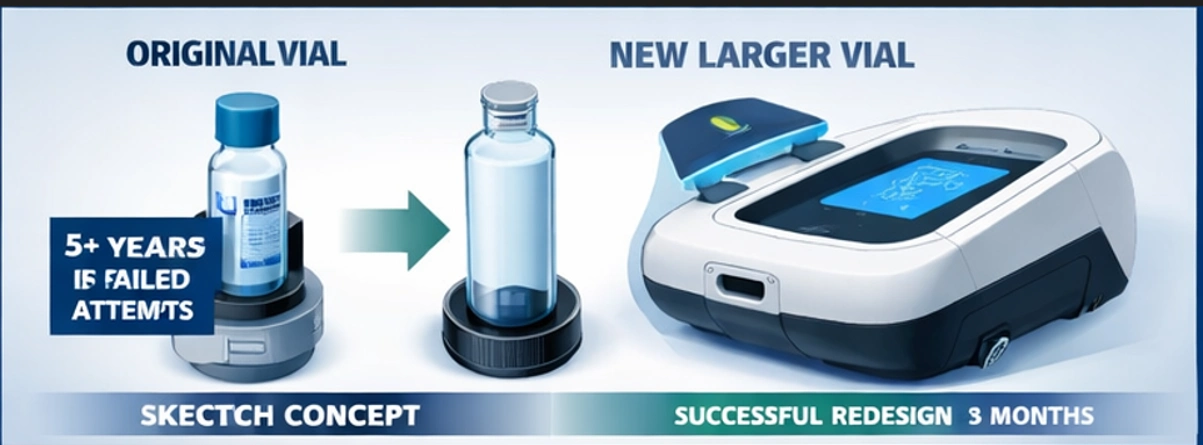
Case study 3: Bigger volume implementation for a medical device
The client, a medtech company operating a Class IIb therapy device, needed to support a vial twice the original volume, overcoming legacy architectural limitations.
1. THE CHALLENGE The client, a medtech company operating a Class IIb therapy device, had been blocked for years by a fundamental architectural limitation: the device could only accept a single, fixed vial size. That constraint was built deep into the mechanical structure, and it prevented the product from entering a high‑value market segment that required a vial twice the original volume.
On paper, the requirement seemed straightforward — support a larger vial. In practice, it was structurally incompatible with the legacy design. For more than five years, multiple internal and external engineering teams attempted incremental modifications, but each attempt failed. Mechanical interference, tolerance stacking, and the rigidity of the original geometry made the redesign effectively impossible within the existing architecture.
Market pressure was escalating. Without compatibility with the larger vial, the company remained locked out of a major opportunity and risked losing competitive ground. After half a decade of unsuccessful attempts, the product was at a standstill with no viable path forward.
2. THE SOLUTION We made the intentional decision to return to first principles. Instead of forcing the larger vial into a structure never designed for it, we removed the entire mechanical assembly and rebuilt the system from the ground up. This clean‑sheet approach freed us from legacy constraints and allowed us to redefine geometry, tolerances, and load paths based solely on functional requirements.
Using new materials and a re‑engineered mechanical layout, we created a structure capable of reliably supporting a vial twice the original size while maintaining stability, usability, and regulatory‑aligned safety margins. CAD‑driven iteration enabled rapid convergence toward a manufacturable design, validating clearances, forces, and assembly feasibility in a compressed three‑month window.
The non‑obvious part was recognizing that incremental redesign was structurally impossible. The original architecture simply could not scale. By starting fresh, we unlocked design freedom that had been inaccessible for years and avoided unnecessary changes to unrelated subsystems, focusing strictly on the mechanical constraints governing vial compatibility.
3. THE RESULTS The new prototype supported a vial twice the original size, passed all mechanical feasibility checks, and opened immediate access to a previously unreachable market segment. After more than five years of stalled attempts, the company gained a viable path forward in just three months.
