Implementing Cellular Connectivity in a Medical Device
How a focused hardware redesign brought reliable cellular connectivity, compliant RF isolation, and EMC performance to a Class IIb medical device.
1. The Challenge
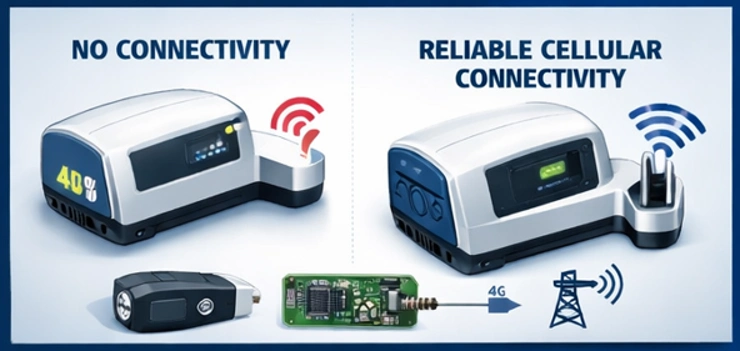
The client needed to add reliable cellular connectivity to an existing medical device — a capability essential for remote monitoring and modern clinical workflows. But the product had no RF architecture, no antenna strategy, and no provisions for power, isolation, or regulatory compliance. Integrating a cellular modem into a Class IIb device introduced noise, thermal load, antenna-placement constraints, and strict EMC and safety requirements. Without a robust implementation, the device could not enter new markets or compete with connected alternatives.
2. The Solution
We implemented a complete cellular communication subsystem through a focused hardware redesign. The PCB was re-engineered to support RF routing, power conditioning, and isolation while maintaining medical-grade EMC performance. We defined the antenna placement and ground strategy to ensure stable signal strength inside a compact enclosure. Layout, shielding, and filtering were optimized to prevent interference with existing electronics, and the design was validated against cellular performance requirements to prepare for regulatory and carrier-specific testing.
The difficult part was integrating a high-power RF module into a device never designed for it. By targeting only the RF, power, and PCB domains that governed connectivity, we avoided unnecessary redesign of unrelated subsystems and delivered a stable, certifiable implementation.
3. The Results
The device gained reliable cellular communication through a clean hardware integration, enabling remote connectivity and unlocking access to new markets — all while remaining compliant and ready for certification.
