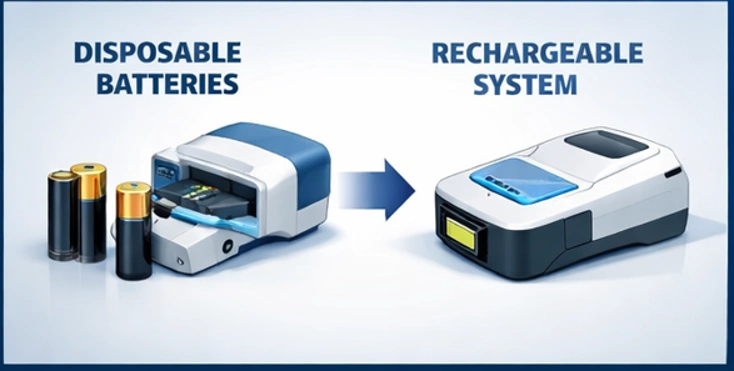
Case study 4: Client asked us to change the actual normal battery to a re-chargeable one.
The client had a legacy device built around disposable batteries. We transitioned the power system to a modern rechargeable architecture with zero functional regression.
1. THE CHALLENGE The client had a legacy device built around disposable batteries, a power architecture that had become a clear limitation: short runtime, inconsistent performance, and rising operational cost. The product had no charging circuitry, no connectors for power input, and no mechanical or PCB provisions for a rechargeable system. Transitioning to a rechargeable battery affected power paths, protection, thermal behavior, and enclosure design — and any misstep risked cascading into a much larger redesign. Without intervention, the device would remain tied to an outdated power model that restricted competitiveness and long‑term value.
2. THE SOLUTION We began with a complete power‑budget analysis, mapping every load, peak current, and duty cycle to define the correct rechargeable chemistry, capacity, and protection strategy. Based on these requirements, we redesigned the PCB to support charging, protection, and stable power delivery. New connectors were introduced for charging and service access, selected for robustness and manufacturability. Mechanically, we engineered a new battery door and integration strategy for the rechargeable pack, optimizing the enclosure modifications to avoid tooling changes wherever possible.
The difficult part was ensuring the new rechargeable system behaved identically — or better — than the disposable‑battery version under all operating conditions. This required precise power‑path engineering, protection‑circuit design, and layout refinement to maintain stability, safety, and regulatory alignment.
3. THE RESULTS The device transitioned from disposable batteries to a modern rechargeable architecture with zero functional regression. The redesign delivered a stable, production‑ready power system that extended runtime, improved user experience, and modernized the product without disrupting certification or manufacturing.
